병원성 세균(Bacterial pathogens)은 전 세계 질병 부담(burden)에 상당 부분 기여한다. 이러한 세균과 인체 건강 사이의 복잡한 상호작용을 이해하는 것은 새로운 진단, 예방 및 치료 전략 개발에 필수적이다. 최신 획기적인 발견들이(breakthroughs) 이런 관계에 대한 이해를 혁신적으로 넓혔음에도 불구하고, 마이크로바이옴 연구의 급격한 확장은 지식이 과학 문헌에 흩어져있는 채로 남아 종합적인 분석과 임상적 적용을 가로마근 주요한 도전 과제가 되고 있다.
이를 해결하기위해, 본 연구는 혁신적인 플랫폼 MINERVA (Microbiome Network Research and Visualization Atlas)을 소개한다. 활용한다 파인 튜닝된 대규모 언어모델을 활용해 광범위한 과학 문헌 전반의 미생물-질병 연관성을 체계적으로 매핑한다. MINERVA는 정확성과 투명성을 우선시하는 풍부한 온톨로지 기반 지식 그래프를 구축하여, 임상 의사 결정과 관련된 기존의 숨겨진 연관성 효율적인 탐색하고 발견할 수 있게 한다.
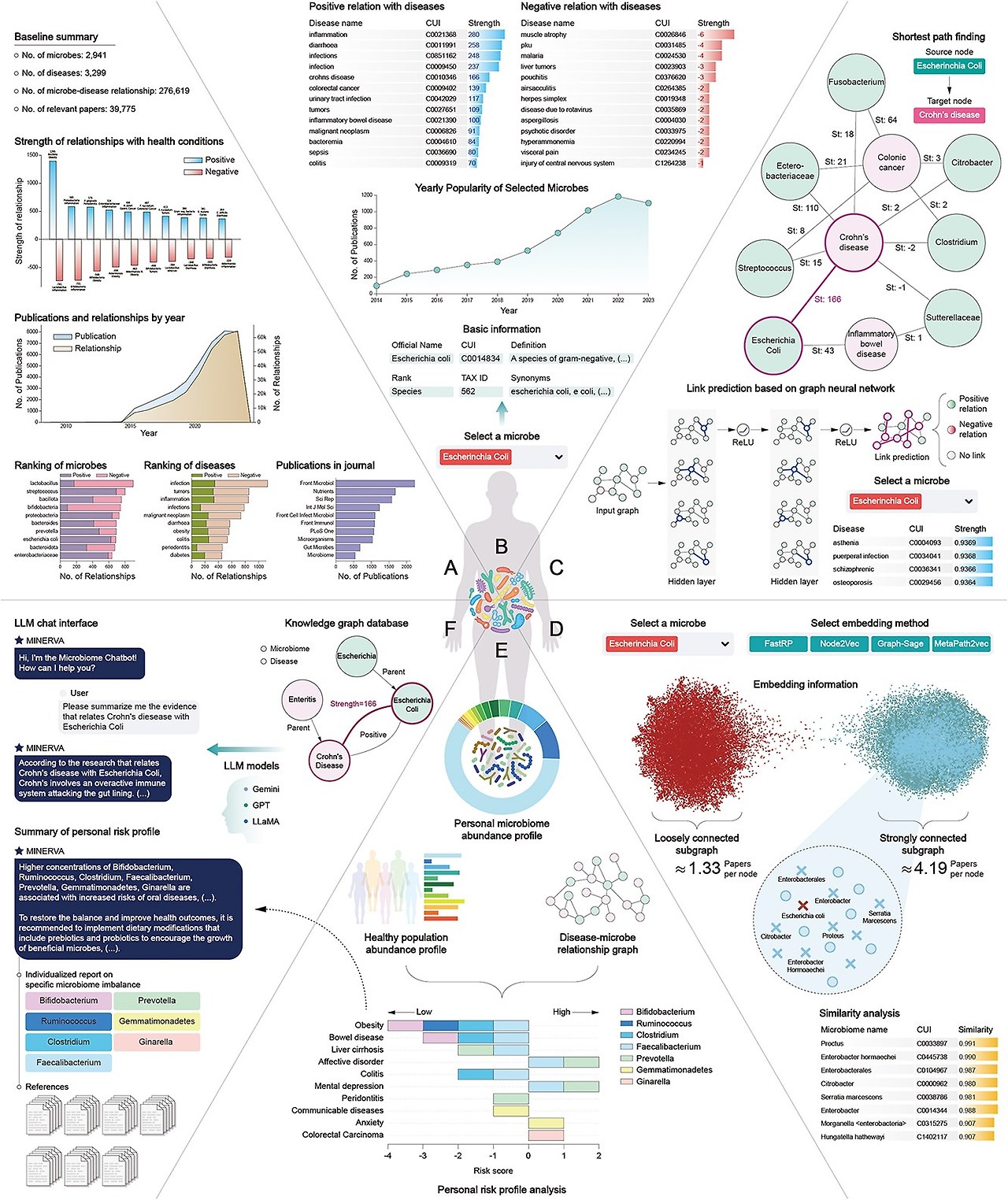
본 플랫폼은 다음과 같은 전문 모듈을 제공한다.
(1) 개인 마이크로바이옴 및 질병 분석,
(2) 지식 그래프 내 복잡한 관계 시각화
(3) 고급 그래프 알고리즘 및 ML 모델을 통한 숨겨진 연결 고리 발굴
(4) 개인 및 인구 집단 수준의 마이크로바이옴 구성 분석
이런 기능은 질병 위험, 동반질환 및 실행가능한 통찰력 도출을 촉지하여 연구와 임상 의사 결정 모두 지원한다. 마이크로바이옴 연구와 실제 응용 사이의 간극을 메움으로써, MINERVA는 미생물-질병 상호작용에 대한 이해를 근본적으로 변화시키고 연구 발견을 가속화하며 환자 치료를 개선할 잠재력을 지니고 있다. The MINERVA platform is available at https://minervabio.org/.
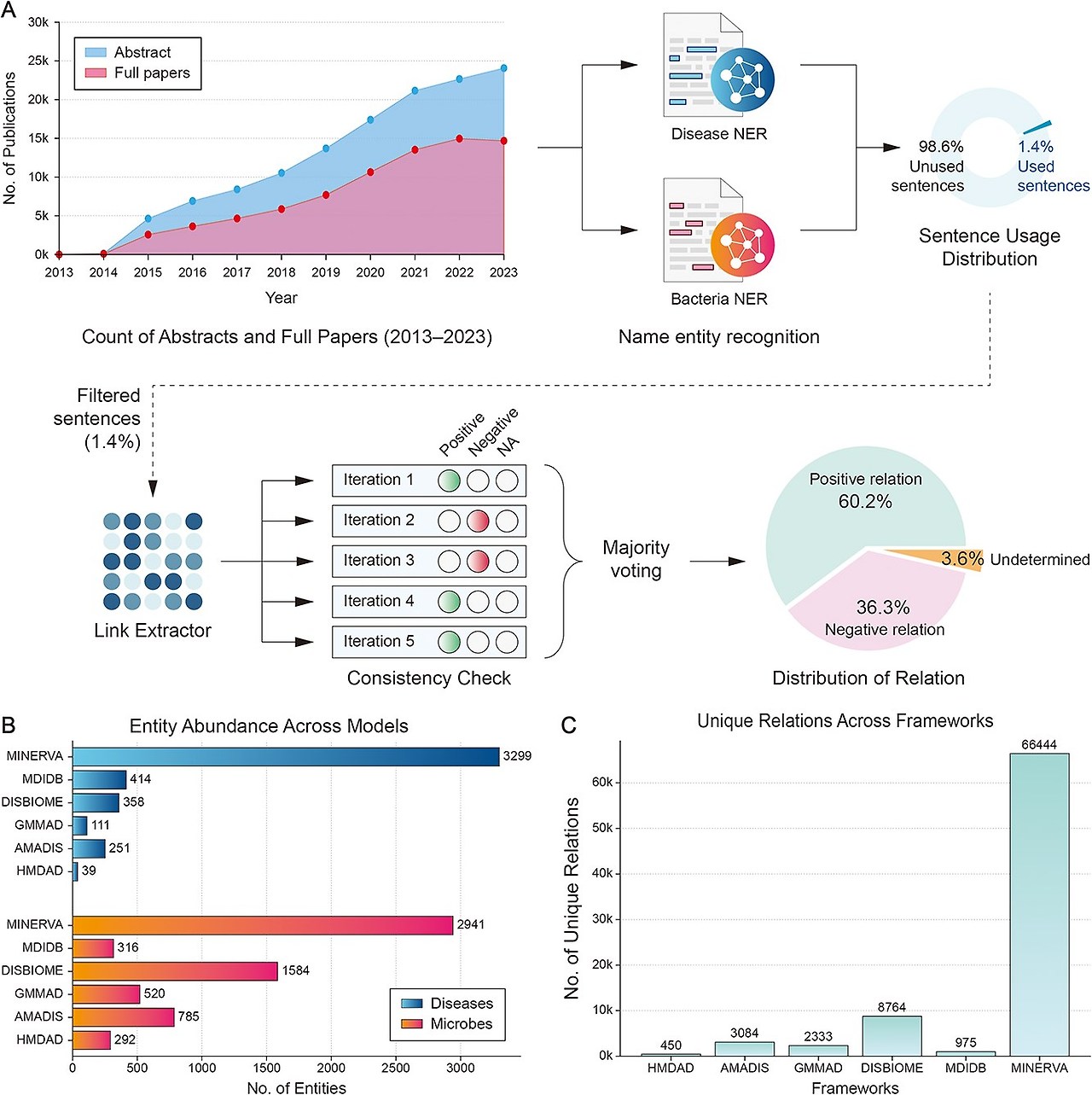
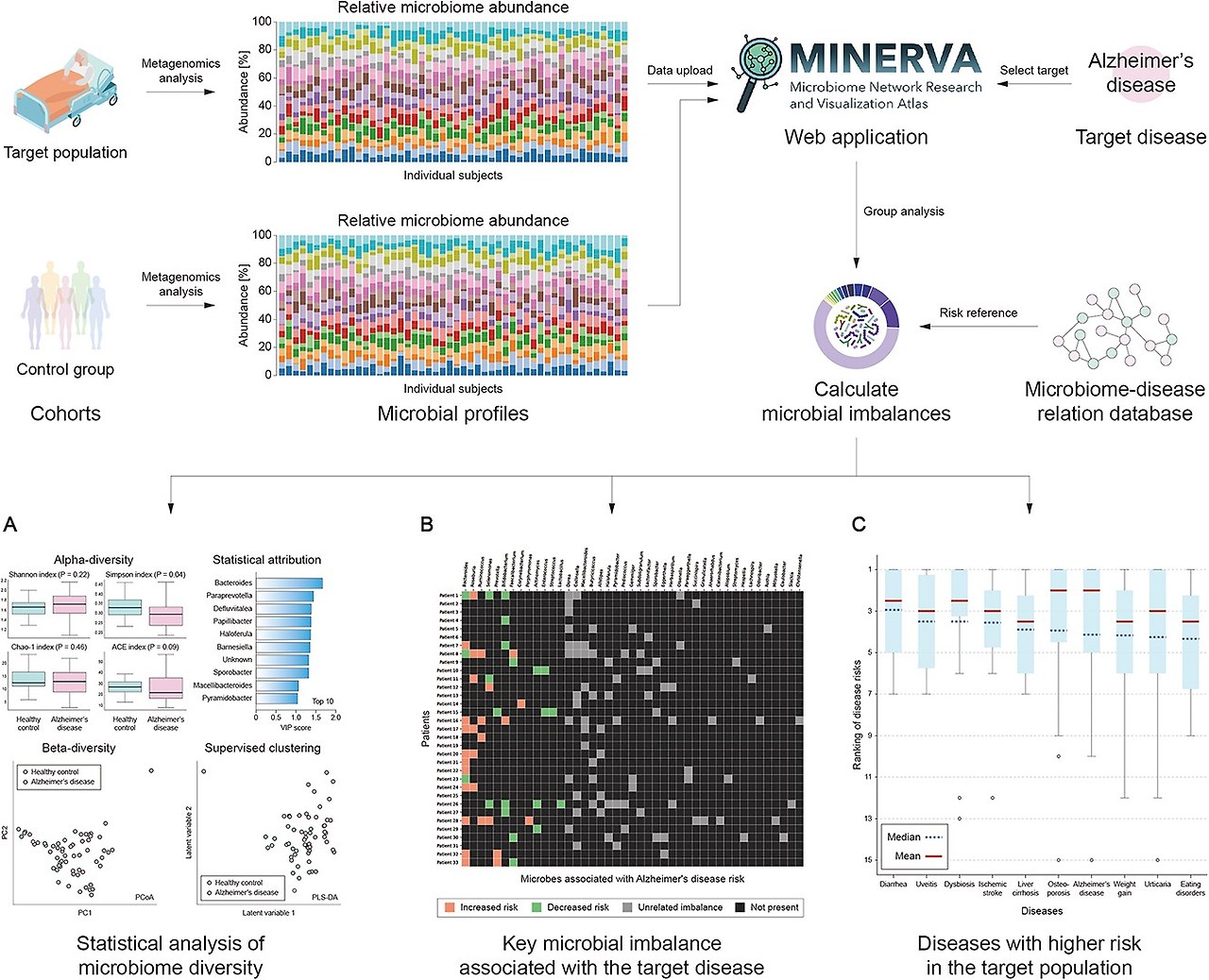
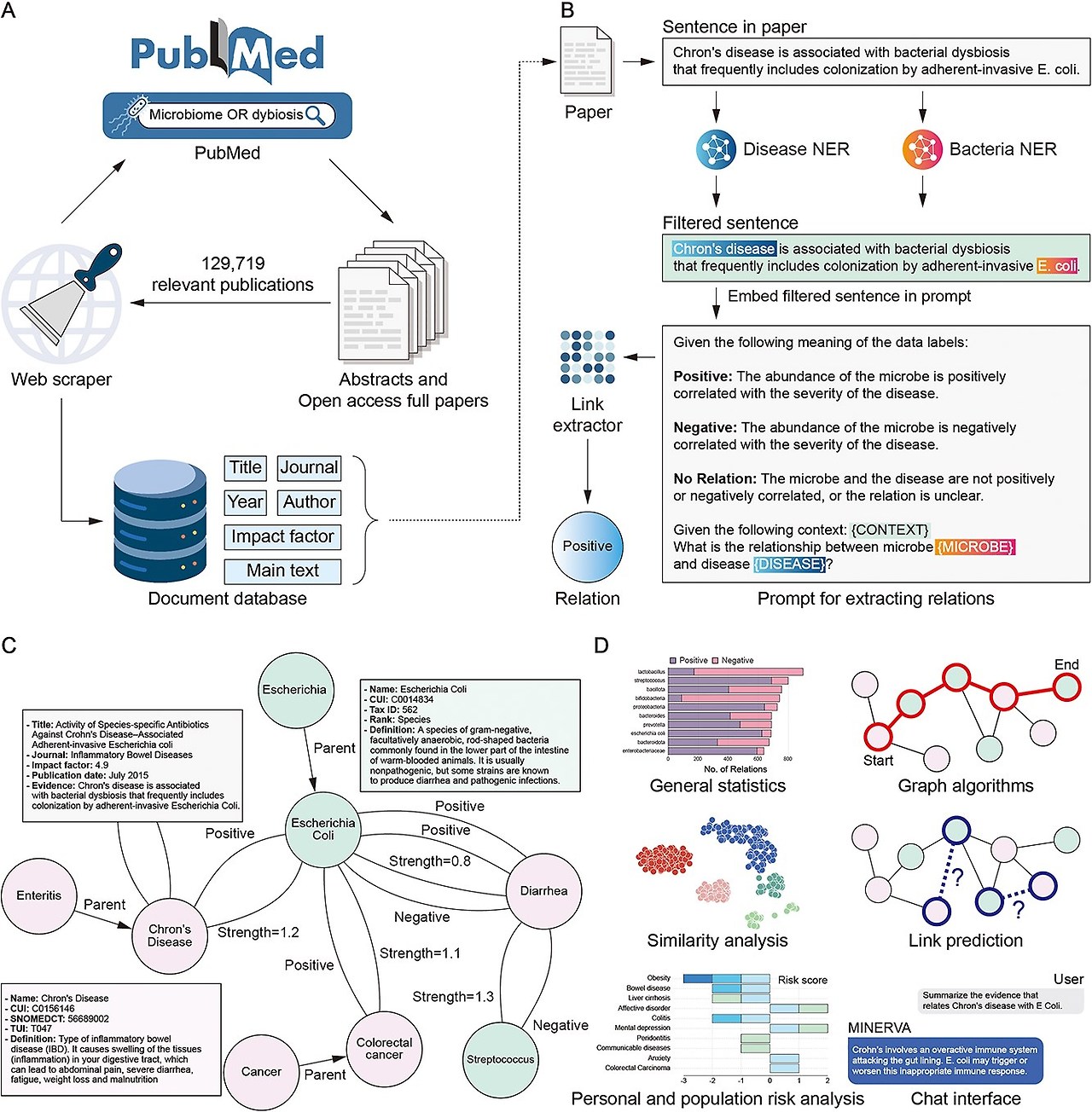
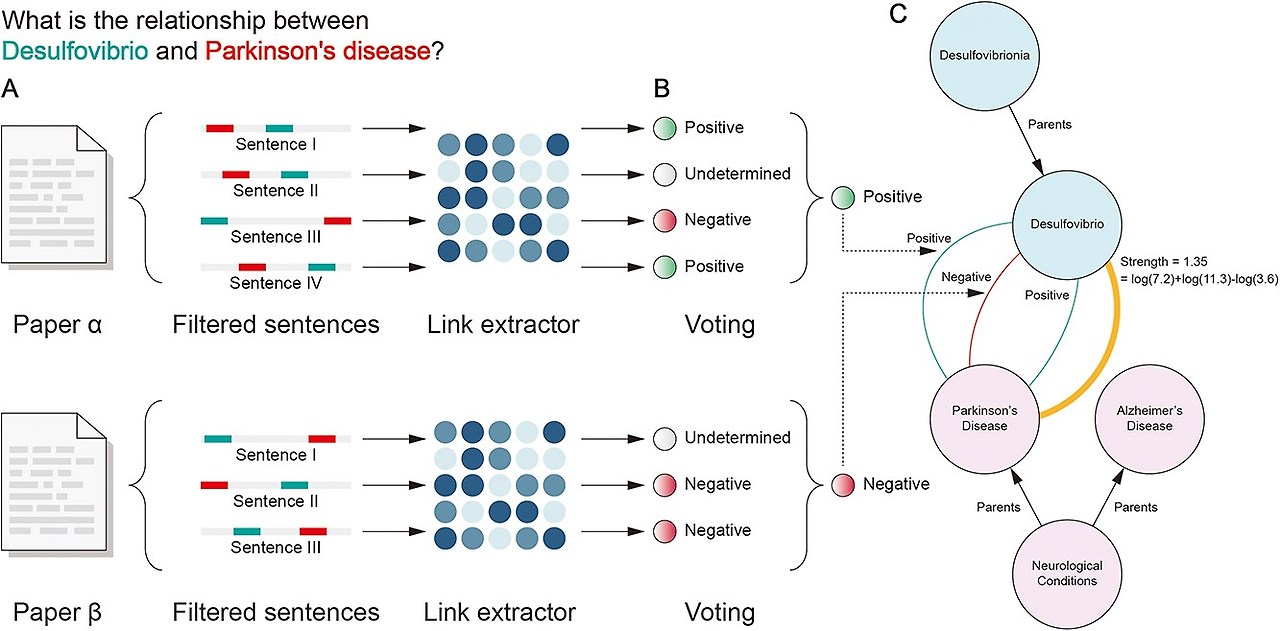
Figure 1MINERVA provides a suite of modules to explore and analyze microbe–disease relationships, including general statistics of the microbe-disease landscape (A), entity analysis (B), link prediction (C), similarity analysis (D), microbiome risk assessment (E), and an interactive chat interface that integrates a conversational LLM with the knowledge graph for intuitive exploration (F).Figure 2MINERVA has analyzed 129,719 publications with advanced NER and GPT-based LLM models, yielding 66,444 validated microbe–disease relationships across 2,941 microbes and 3,299 diseases, surpassing existing resources.Figure 4 Population risk assessment module. After uploading the microbial profiles of a target population and (optionally) of a control group. MINERVA calculates the microbial imbalances of the target population and delivers multiple insights, which can be broadly divided into three: (A) statistical analysis: Metrics such as -diversity and -diversity, along with methods like PLS-DA, are used to compare microbial diversity and identify key discriminative microbes between groups. (B) Disease-specific microbial imbalances: If a target disease is specified, MINERVA will automatically highlight which microbial imbalances are associated to the target disease, providing actionable insights into the microbiome-disease relationship. (C) Risk of diseases: MINERVA calculates and ranks disease risks across the population using its knowledge base, aiding in the identification of potential comorbidities and enhancing diagnostic accuracy. The Population Risk Assessment module analyzes microbial profiles to compare diversity (A), identify disease-specific imbalances (B), and rank disease risks (C), providing actionable insights into microbiome–disease relationships.Figure 5 MINERVA’s pipeline (A) collected 129,719 publications from PubMed/PMC, (B) applied NER models and an LLM to extract microbe–disease relationships, (C) validated and integrated these relationships as triplets into a knowledge graph, and (D) developed a user-friendly platform with analytical modules for exploration and discovery.Figure 6 MINERVA’s knowledge graph is built through a three-step process that requires full LLM confidence (A), applies majority voting within publications (B), and updates relationship strength across studies to ensure accuracy and reliability (C).